
Related
Products
Yellow
Cedar
chamaecyparis nootkatensis
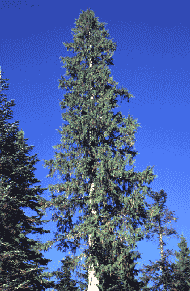
A medium-sized tree, up to 80 feet tall and 3 feet in diameter; has a broad, grooved trunk that spreads out widely at the base. The crown is sharply cone-shaped, with branches that spread out and droop, and have small, loosely hanging branchlets.
The leave are scale-like, dark, bluish-green, and slender with sharp points. Unlike western red cedar, the leaves of the yellow-cedar are all alike, so that the leaf-covered twigs appear four-sided rather than flat.
Cones are round, 1/4 to 1/2 inches in diameter, berry-like in the first year and becoming woody as they mature. Mature cones have 4 to 6 thick umbrella-shaped scales.
On young trees, the bark is thin, grayish-brown and scaly; on mature trees, it has narrow intersecting ridges. The inside of the bark smells like potato skins.
Common west of the Coast Mountains, plenty in Alaska and it rarely occurs in southeastern British Columbia
Yellow-cedar grows well on deep, slightly acidic, moist soils, usually as single trees, or in small clumps. It is common in old-growth stands at low elevations especially in the mid or north coastal regions, with western red cedar and western hemlock and other plants such as salal and deer fern. It is most common at high elevations, growing with mountain hemlock and amabilis fir.
The wood from Yellow Cedar has always been highly prized because of its many superlative qualities. Its distinctive and uniform yellow color is much admired. The narrow band of sapwood is very similar in color to the heartwood. The wood is exceptionally fine in texture and has an unusually straight grain. When green, the wood has a pungent sulphur odor. One of the world's most durable timbers, Yellow Cedar has excellent resistance to decay, insect attack and marine borers, a property that contributes to its exceptional long life. It is a relatively hard wood, considerably harder than most commercial softwoods, and has excellent strength and wear properties as well as good impact resistance.
Aboriginal people along the coast used yellow-cedar extensively. They used the wood for paddles, masks, dishes, and bows and wove the bark to make clothing and blankets. Yellow cedar presently are also used for making outdoor furniture and garden products,
The wood is very valuable commercially because of its dense structure, straight grain, yellow color, and resistance to decay. It is used extensively for boat building.