|
| |
Tools and material check list :
| Power Drill |
Screws |
| Bamboo Molding |
Steel Measuring Tape |
| Hammer |
Level |
| Nail Set |
Miter Box |
| Backsaw |
Coping Saw |
| Nails |
Putty Knife |
There are a few different types of
bamboo moldings that works
with our bamboo ceiling and wall covers. The most common interior
moldings can be divided into three basic functions:
 | Bamboo ceiling molding can cover the gaps between the wall and the
ceiling. |
| Bamboo base molding can cover the gaps between the floor and the
walls. |
This document will help you install these basic
types of bamboo moldings. You'll be able to put a finishing touch to just
about any type of bamboo project.
Our bamboo molding is made out of mature thick wall Moso
bamboo. Our bamboo molding is processed and machined to match the needs of
molding projects.
Step 1
TYPES OF MOLDINGS
| Our ceiling molding is machined cut to install to join
the wall and ceiling. |
| Bamboo base molding comes in a variety of different sizes and
styles. They can be combined for a traditional look. Our bamboo base molding
can be used in conjunction with a base shoe, a small quarter round molding
that is applied on the base for a finished look. |
Step 2
WORKING WITH BAMBOO BASE MOLDINGS
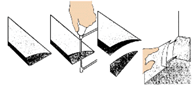
Fig A
| The first step is to locate the wall studs and mark their
location on the wall just above the height of the baseboard with a light
pencil mark. When you buy bamboo ceiling and base molding, try and buy
lengths that will allow you to make complete runs without joints; if you
can't do so, add 2' to any lengths that will be joined, so you can cut the
joint over a stud. |
| To install base molding, start from any door. Measure
from the door to the nearest wall. Cut the end of the first piece of base
square, then measure the door-to-wall distance and cut the other end, also
square. Pre drill a pilot holes through the bamboo moldings and nail the
first piece in place with pairs of 6d finish nails driven into each stud and
the floor plate it rests on. |
| The second piece of base will be joined to the first with
a coped cut at the inside corner (see image above fig A). To make a coped
cut, first cut the end of the piece at a 45-degree angle with the short side
of the miter toward the face of the piece. Finish the cut with a coping saw,
carefully following the cut edge along the face of the piece (see image).
|
| Measure from the bottom of the first piece of base to the
next corner, then square-cut the second piece at the other end so it butts
into the corner. Repeat the process for each inside corner. |
| Use a miter cut at outside corners. Few outside corners
are exactly 90 degrees, so you'll have to use a T-bevel to find the exact
angle, then divide by two and cut each piece of base to that angle.
|
| If you need to join two pieces of molding in the middle
of a run, set the first piece in place and mark the center point of the stud
nearest to the end of the piece. Subtract half the thickness of the molding,
then cut the end using an open miter cut (see image). Install the first
piece, but don't nail over the last stud where the piece is mitered.
|
WORKING WITH BAMBOO BASE MOLDINGS
| Ceiling molding is installed much like base molding,
except that ceiling molding is not applied flat against the wall. Instead,
it covers the joint at a 45-degree angle. |
| If you have nothing but inside corners to deal with, the
process is easy-simply install each piece with a square cut at one end and a
coped cut at the other. |
| If you have outside corners, they'll have to be mitered.
Again the process is simple, as long as you clamp the molding in the miter
saw at the same 45-degree angle at which it will be installed. |
| To avoid damaging the surface of the molding, drive the
nail to within an 1/8" of the surface. Use a nail set to finish driving the
nail. Putty can be used to fill the nail hole. |
Check your state and local codes before starting any
project. Follow all safety precautions. Information in this document has been
furnished by MGP. Every effort has been made to ensure accuracy and safety.
Neither MGP, or any contributor nor the retailer can be held responsible for
damages or injuries resulting from the use of the information in this
document.
|
 Gardeners' Corner
Kids'
Garden
Sustainable Garden
Go
Shopping
Gardeners' Corner
Kids'
Garden
Sustainable Garden
Go
Shopping